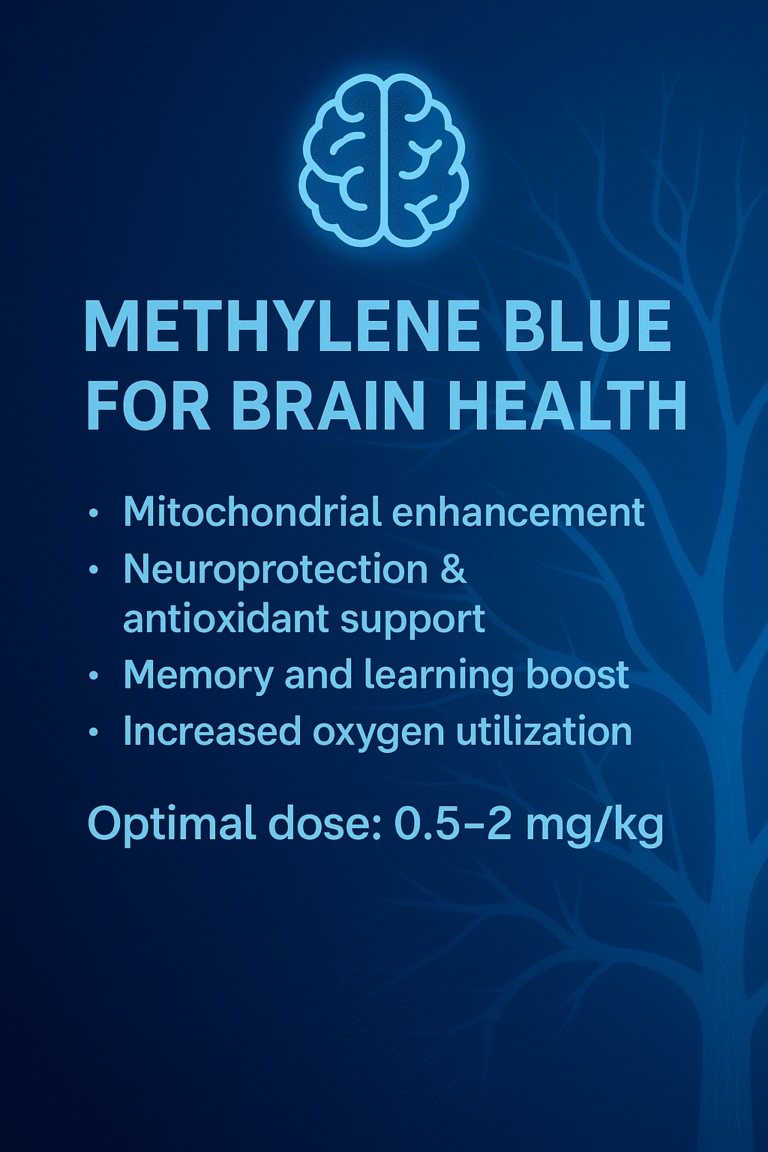
What Does Methylene Blue Do For Brain Health? A Biohacker's Guide
Methylene Blue (MB) may look like industrial dye — but for those of us chasing cognitive clarity, performance longevity, and neurological resilience, it might just be one of the most promising nootropics in modern pharmacology.
But what exactly does it do to the brain?
This guide breaks down the mechanisms, benefits, and cutting-edge research on MB for mental performance and long-term brain health.
🚀 1. It Supercharges Mitochondria — Your Brain’s Energy Plants
Your brain uses more energy per gram than any other tissue. MB acts as an electron cycler, accepting and donating electrons in the mitochondrial electron transport chain (ETC), particularly between Complexes I–III. This bypasses dysfunctional pathways, enhancing ATP production even under oxidative stress or disease conditions .
In other words: It keeps your brain energized — even when under fire.
🧬 “MB donates electrons directly to cytochrome c, bypassing damaged parts of the ETC and restoring ATP production.”
— Gonzalez-Lima & Auchter (2015)
🧠 2. It Enhances Memory and Learning
Multiple animal studies show improved memory retention and learning speed following MB administration.
One study demonstrated reduced memory extinction and enhanced retention in rats after MB supplementation, suggesting potential for cognitive reinforcement in humans .
MB increases cerebral blood flow and metabolic activity in regions responsible for working memory and long-term recall .
This aligns with anecdotal feedback from high performers using low-dose MB to aid mental clarity, focus, and recall under cognitive load.
🛡️ 3. It Acts as a Neuroprotective Agent
Methylene Blue is remarkably neuroprotective against oxidative stress, neurotoxins, and inflammation.
It reduces reactive oxygen species (ROS) without inhibiting necessary immune signaling.
It maintains mitochondrial integrity in models of Alzheimer’s, Parkinson’s, and traumatic brain injury .
MB’s antioxidant action is self-limiting — it only scavenges free radicals when needed, avoiding the “blunting” effect seen in other antioxidants like Vitamin C or E .
📈 4. It Boosts Brain Oxygen Efficiency
In low-oxygen or hypoxic states (like intense training or altitude), MB helps the brain maintain function by increasing cytochrome c oxidation and sustaining cellular respiration.
This makes it especially valuable for:
High-altitude performance
Ketogenic or fasting states
Supporting oxygen-deprived tissues post-injury
In one study, MB improved cognitive function in elderly individuals experiencing transient hypoxia — showing promise for both athletes and aging populations .
🧪 5. The Ideal Dosing Range for Cognitive Benefits
Low doses (0.5–4 mg/kg) are effective. In fact, lower is often better — higher doses can act as pro-oxidants or disrupt redox balance .
Anecdotal biohacker consensus and clinical trials tend to hover around:
0.5–2 mg/kg orally for cognitive enhancement
Taken intermittently, not daily, to avoid adaptation or tolerance
⚠️ Final Note on Purity & Safety
Only pharmaceutical-grade MB should ever be used for internal purposes. Avoid aquarium or industrial dyes. MB is photosensitive, so storage and use should consider light exposure. Certain populations — especially those with G6PD deficiency or on SSRIs — should consult medical advice.